
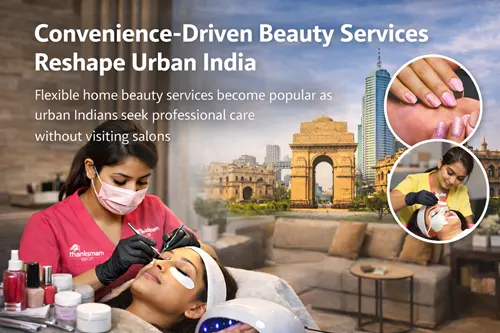
Thanksmam India’s beauty and wellness industry is quietly undergoing structural change. What was once a location-bound service, centered around neighborhood salons and commercial outlets, is increasingly becoming mobile and home-oriented. Driven by evolving work patterns, rising digital adoption, and greater awareness around hygiene, convenience-led beauty services are gaining acceptance across urban and semi-urban regions.
Among the newer companies operating within this space is Thanksmam Salon – Best Home Salon, a salon-at-home beauty service provider founded in October 2024 and headquartered in Greater Noida. While still in its early growth phase, the company reflects a broader industry movement toward decentralized service delivery models.
Urban Lifestyles and the Demand for Flexibility
Urban India’s lifestyle has changed significantly over the past decade. Dual-income households, long commutes, and irregular working hours have reshaped how consumers allocate time for personal care. As a result, services that reduce travel and waiting time are increasingly preferred.
Beauty and grooming, traditionally dependent on physical salons, are now adapting to this demand for flexibility. Salon-at-home services allow customers to schedule appointments around their daily routines, often with greater privacy and control over the service environment.
Industry analysts observe that this shift is not limited to high-income groups. Middle-income households in tier-2 cities are also adopting home-based services as awareness and accessibility increase.
Company Formation and Early Direction
Thanksmam Salon was established on 12 October 2024 by Preeti Kumari, with operations based in Greater Noida. Rather than opening physical outlets, the company adopted a mobile service model from the outset—deploying trained beauty professionals directly to customer homes.
According to company information, the early focus was on building standardized service procedures, onboarding skilled professionals, and creating hygiene guidelines suitable for home environments. This operational groundwork is often seen as essential for ensuring consistency in service-heavy businesses.
Within its first year, Thanksmam Salon assembled a workforce of approximately 40 employees, including beauticians, nail technicians, eyelash specialists, and operational support staff.
Services Adapted to At-Home Delivery
The success of salon-at-home models depends largely on how well services can be adapted for residential settings. Thanksmam Salon’s offerings include a range of treatments commonly requested by urban customers.
These services include:
Nail extensions and nail art
Eyelash extension services
Facials and hydra facials
Waxing, threading, cleanup, and other grooming services
All services are delivered using portable tools and branded products. The company emphasizes hygiene practices such as tool sterilization and disposable materials, which are considered critical factors for customer trust in home-based services.
Experts note that as this segment matures, customers are becoming more discerning, often comparing home services directly with premium salon experiences.
Expansion Beyond Metro Centers
Although headquartered in Greater Noida, Thanksmam Salon has expanded operations to several other cities within a short span. As of 2025, its services are available in Noida, Delhi, Gurgaon, Faridabad, Ghaziabad, Jaipur, and Lucknow.
This geographic spread highlights how salon-at-home services are no longer restricted to large metropolitan areas. Tier-2 cities, supported by rising internet penetration and changing consumer preferences, are emerging as important markets.
However, expansion also introduces operational challenges, including travel logistics, appointment scheduling, and maintaining consistent service quality across locations.
Measuring Early Growth
Within its first year of operations, Thanksmam Salon reports having served around 1,500 to 2,000 customers across its service regions. While these figures are modest when compared with national-level platforms, they represent steady adoption for a new entrant relying primarily on organic growth.
Industry experts often emphasize that in service-based sectors, sustainable growth is built on repeat customers and local reputation rather than rapid scaling alone.
Impact on Employment in the Beauty Sector
The salon-at-home model is also influencing employment patterns within the beauty industry. Traditional salons typically operate on fixed schedules, which may not align with the needs of all professionals.
Home-service models offer greater flexibility, allowing professionals to work across different locations and appointment times. For many skilled workers, this can provide better work-life balance and income opportunities.
Thanksmam Salon reports ongoing internal training and performance monitoring to ensure that professionals meet service and hygiene standards.
Digital Platforms and Customer Trust
Digital tools play a central role in the functioning of salon at home businesses. Booking systems, service details, and customer communication are primarily handled online. Thanksmam Salon maintains an active presence through its official website and social media platforms, including Instagram, LinkedIn, and YouTube.
In the absence of physical storefronts, online visibility and customer reviews become key trust signals. Industry observers note that transparency, clear pricing, and responsive customer support are critical success factors in this category.
Competitive Pressures and Market Realities
As salon-at-home services gain popularity, competition within the segment is intensifying. Customers can choose from independent freelancers, local salons offering home visits, and large digital platforms with nationwide reach.
For smaller brands, differentiation often comes from service consistency, professional conduct, and localized customer relationships rather than scale or heavy advertising. Maintaining quality while managing costs remains a common challenge.
A Sector in Transition
The rise of convenience-driven beauty services suggests a lasting change in how personal care is accessed in urban India. As consumers continue to prioritize flexibility, hygiene, and personalized experiences, home-based beauty services are likely to remain relevant.
Companies like Thanksmam Salon, still early in their journey, illustrate how emerging service models are reshaping traditional industries. Their long-term success will depend on how effectively they balance growth with operational discipline in a competitive and evolving market.
